


Tokachi-ishi
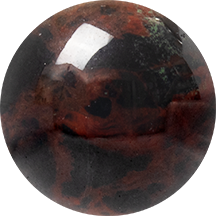
Tokachi-ishi ("Tokachi stone") is the name commonly used in Hokkaido, Japan, for obsidian, a natural volcanic glass; it is a regional name, not a separate mineral or rock. The Shirataki area of Engaru Town is known as Japan's largest obsidian source. Petrologists call the rock kokuyōgan (obsidian), and it is untreated natural material.
Products made with this material
Showing 1 of 1 products
Full material guide
What the material is, where it comes from or how it is made, identification and care, from the cited sources.
Properties
| Nature | Natural volcanic glass (a glassy volcanic rock) |
| Rock | Obsidian (kokuyōgan) |
| Composition | Rhyolitic to dacitic glass, about 70% SiO₂, usually under 1% water |
| Color | Black to gray, red to reddish brown, sometimes nearly colorless; red-streaked pieces are called hana-tokachi |
| Cause of color | Black from layered magnetite grains in the glass; red or brown where magnetite oxidized to hematite |
| Fracture | Conchoidal, giving sharp flakes |
| Luster | Vitreous |
Origins & sources
Shirataki obsidian formed about 2.2 million years ago, when renewed volcanic activity followed a large eruption about 3 million years ago; rapidly chilled outer parts of viscous lava became obsidian, while slowly cooled interiors became rhyolite. The main source area is Akaishiyama in Shirataki; at the Tokachi-Ishizawa lava the obsidian layer is about 7 m thick.
Identification
Under the microscope the rock is colorless glass with crystallites (globulites, margarites and trichites) and occasional quartz, plagioclase, biotite or hornblende crystals; white spherulites and banded flow structure may be visible. It breaks with a conchoidal fracture into sharp flakes. It is distinguished from pitchstone, a related volcanic glass, by its low water content (usually under 1%, versus about 4–10%).
Care
Obsidian is brittle and chips or breaks easily on impact, and with a hardness of about 5 to 5.5 it scratches easily, so it suits earrings, pendants and brooches better than rings or bracelets. Household dust (hardness about 7) is harder than obsidian, so wipe it with a lint-free cloth instead of scrubbing it dry. Inclusions can expand when heated, so avoid mechanical cleaning systems and use mild soap, a soft brush and warm water.
History
The word 黒曜石 (kokuyōseki) appears in Kiuchi Sekitei's Unkonshi (1801) and was adopted as the translation of "obsidian" by Wada Tsunashirō in 1878. In 1846 the explorer Matsuura Takeshirō recorded that the same stone was called Monbetsu-ishi along the Yūbetsu River and Tokachi-ishi in the east; in the Meiji era, crafts made from Tokachi obsidian spread the name Tokachi-ishi across Hokkaido. Older names include anchi (anji) in Ainu, kokugyokuseki and kurozuishō. Shirataki obsidian was used for stone tools from the Paleolithic (artifacts probably about 30,000 to 15,000 years old), and was carried as far as Sakhalin in the north and Yamagata and Niigata in the south; artifacts from the Shirataki site group were designated a National Treasure in 2023, and Shirataki Geopark was certified as a Japanese Geopark in 2010.
Cultural meanings
Not collected yet
Traditional beliefs
Not collected yet
Collected Oct 23, 2026
- 黒曜石と白滝ジオパーク (「ほっかいどう学」第29回) Hokkaido Kaihatsu Kyokai; author Seshimo Naoto, curator, Engaru Town Buried Cultural Property Center · Accessed Oct 23, 2026 OverviewPropertiesOrigins & sourcesHistory
- 黒曜石とトカチ石【コラムリレー第43回】 Hokkaido Museum Association curators section (Engaru Town Buried Cultural Property Center curator Matsumura Yubun) · Accessed Oct 23, 2026 OverviewHistory
- 黒曜石ができるまで【コラムリレー第14回】 Hokkaido Museum Association curators section (Shirataki Geopark geologist Sano Kyohei) · Accessed Oct 23, 2026 OverviewOrigins & sources
- 地学 Sheets 調査研究編 No.1 黒曜石とは何か? Asahikawa City Museum (curator Mukai Masayuki) · Accessed Oct 23, 2026 OverviewPropertiesIdentification
- 黒曜石のふるさと 北海道・白滝の石器 Osaka Museum of History · Accessed Oct 23, 2026 OverviewHistory
- Obsidian Value, Price, and Jewelry Information International Gem Society (Joel E. Arem, Ph.D., FGA) · Accessed Oct 23, 2026 Care
- Obsidian: Igneous Rock - Pictures, Definition, Formation Geology.com (Hobart M. King, PhD) · Accessed Oct 23, 2026 Care