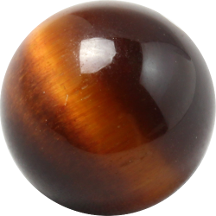
Red Tiger's Eye

Red tiger's eye is tiger's eye, a natural chatoyant variety of quartz, with a brownish-red to dark red colour that is normally the result of treatment. Gemdat (citing Lazzarelli) and IGS state that tiger's eye is heat-treated to develop red colours, and Gemdat calls the dark red heated material "bull's eye"; IGS also illustrates red cabochons that are dyed. The Japanese retailer Pascle likewise states that most red tiger's eye on the market is heated yellow tiger's eye.

Products made with this material

Category
Category
Color
Color

Colors are read from each product’s main photo.

Bead diameter (mm)
Bead diameter (mm)

Only round beads with a verified diameter. A product matches when its stated size range overlaps yours, limits included; a material matches when any of its round sizes does.

Price (USD)
Price (USD)
Availability

Showing 1 of 1 products

Full material guide
Material facts

What the material is, where it comes from or how it is made, identification and care, from the cited sources.

Properties

Nature Treated natural material: tiger's eye (quartz), usually heated; some pieces are dyed
Base material Tiger's eye: quartz with included, altered crocidolite fibres
Chemical formula SiO₂ (quartz host)
Color Brownish red to dark red
Treatment Heating (develops red colour); dyeing in some pieces
Crystal system Trigonal (quartz host)
Mohs hardness Tiger's eye: 7 (IGS, Mindat); Gemdat gives 6.5 to 7
Specific gravity Tiger's eye: 2.58 to 2.64 (Gemdat); IGS gives 2.55 to 2.91
Refractive index Tiger's eye: 1.544 to 1.553 (IGS); Gemdat gives 1.534 to 1.540
Cleavage and fracture No cleavage; conchoidal fracture
Luster Vitreous
Transparency Opaque
Optical phenomenon Chatoyancy (a moving band of light, the cat's-eye effect)

Origins & sources

Red tiger's eye starts as natural golden tiger's eye; its red colour is developed by heating or, in some pieces, added by dyeing. IGS lists Australia, China, Namibia, South Africa, England and the United States as sources of tiger's eye. The sources read do not document where the material is heated.

Identification

It shows the same silky moving band of light and fibrous structure as yellow tiger's eye, but in brown-red to dark red. Because heating is a standard treatment for this colour, red tiger's eye should be assumed to be treated unless shown otherwise; GIA notes that a qualified gemologist can detect dyed gems in most cases. Chatoyant glass and plastic made from fused optical fibres imitate cat's-eye stones in any colour.

Care

IGS rates the wearability of tiger's eye as very good; it has a hardness of about 7 and no cleavage. For pieces that are dyed rather than heated, GIA advises avoiding solvents such as acetone or alcohol, which can dissolve dyes, and prolonged sunlight, which can fade them.

History & culture

History

Not collected yet

Cultural meanings

Not collected yet

Traditional beliefs

Not collected yet

Sources

Collected Oct 23, 2026