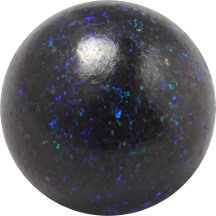
Black Matrix Opal

Black matrix opal is a trade name for precious opal finely distributed through a host rock (matrix) with a dark background. The best-documented material is Andamooka matrix opal from South Australia: a cream to grayish white porous rock with specks of precious opal that is usually blackened by sugar-acid carbon treatment. Such stones are therefore commonly a treated natural material, not natural black opal; naturally dark matrix opal in black volcanic rock is also reported from Honduras and Nicaragua.

Products made with this material

Category
Category
Color
Color

Colors are read from each product’s main photo.

Bead diameter (mm)
Bead diameter (mm)

Only round beads with a verified diameter. A product matches when its stated size range overlaps yours, limits included; a material matches when any of its round sizes does.

Price (USD)
Price (USD)
Availability

Showing 1 of 1 products

Full material guide
Material facts

What the material is, where it comes from or how it is made, identification and care, from the cited sources.

Properties

Nature Rock with precious opal (opal in host rock); usually treated natural (carbonised)
Composition Mix of silica spheres and finer-grained amorphous or partly crystalline silica in a porous rock (Andamooka)
Treatment Sugar-acid carbonisation: black carbon deposited in the pores of the matrix, usually only near the surface
Mohs hardness 6 (treated Andamooka matrix opal)
Specific gravity 1.98 to 2.05 (treated Andamooka matrix opal)
Refractive index 1.44 to 1.45 (spot reading)
Color Opaque black body with patchy to spotty play-of-color

Origins & sources

Andamooka lies a little over 500 km north-northwest of Adelaide, South Australia. There, matrix opal formed where opal partly replaced limestone boulders and filled pore spaces in sandstone and claystone; in Australia this kind of matrix opal appears to be restricted to the Andamooka fields. Since the mid-1950s it has been darkened by a sugar-acid process: the prepolished stone is soaked in an acidified sugar solution, heated, then heated in concentrated sulfuric acid, which reduces the sugar to black carbon in the pores. Variants without acid, using sugar and baking, are also used. Natural black matrix opal in black basalt is reported from Nicaragua, and black opal matrix from Honduras is sold as "Black Honduran Opal".

Identification

Under a 10x loupe, treated Andamooka matrix opal shows a granular groundmass with black carbon particles around patches of precious opal and filling voids and fractures. Compared with Lightning Ridge black opal, it lacks the velvety polish, has an opaque, uniformly black body (natural black opal is usually dark blue, green, brown or gray) and shows patchy to spotty play-of-color. A chip may reveal the original whitish matrix beneath the thin black layer. The Japanese retailer Pascle notes that black matrix opal is often confused with black opal, and that depending on the proportion of opal and sandstone it may be classed as opal or as opal-bearing sandstone.

Care

Avoid damage to the surface: the carbon impregnation is often no deeper than 1 mm, and repolishing may remove the black color. Treated stones should also be protected from strong heat and harsh chemicals, like other opal, and cleaned with a damp cloth rather than in an ultrasonic cleaner.

History & culture

History

Not collected yet

Cultural meanings

The Japanese retailer Pascle gives black matrix opal the meanings it associates with opal in general, saying it is traditionally believed to encourage creativity, and presents it as a charm for success at work. Pascle lists it among October birthstones in Japan. These are retail traditions, not verified properties.

Traditional beliefs

Not collected yet

Sources

Collected Oct 23, 2026