Hidaka Jade

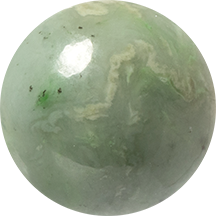
Hidaka jade is a natural green rock from Chisaka in Hidaka Town, Hokkaido, made mainly of chromian diopside (diopside containing about 1% chromium). Despite its name it is neither jadeite nor nephrite; it was named for its jade-like interlaced texture, toughness and translucent green color and is sometimes called the "third jade". Found in 1966, the deposit was worked out within about three years.

Products made with this material

Category
Category
Color
Color

Colors are read from each product’s main photo.

Bead diameter (mm)
Bead diameter (mm)

Only round beads with a verified diameter. A product matches when its stated size range overlaps yours, limits included; a material matches when any of its round sizes does.

Price (USD)
Price (USD)
Availability

Showing 1 of 1 products

Full material guide
Material facts

What the material is, where it comes from or how it is made, identification and care, from the cited sources.

Properties

Nature Natural rock (chromian diopside rock); not jadeite or nephrite
Main minerals Chromian diopside containing about 1% chromium
Accompanying minerals Uvarovite (dark green spots), chromian spinel (black spots), pectolite and wollastonite (white parts), chlorite and tremolite-group amphiboles
Texture Interlaced (felted) fibrous texture that makes it tough
Color Green to bright yellow-green, with translucency and a greasy feel

Origins & sources

Hidaka jade was found in the Penke-yukutorashinai stream, a tributary of the Chiroro River at Chisaka, Hidaka Town. It occurs in rodingite derived from serpentinite, along the boundary between serpentinite and rodingite, where chromium from the chromian spinel-bearing serpentinite was taken up into new minerals. The material was actively mined and sold as jewelry in the late 1960s to the 1980s (Showa 40s–50s), but the deposit appears to have been exhausted within about three years of its discovery.

Identification

Mineralogically Hidaka jade is chromian diopside, not jadeite (the mineral of jadeite jade) and not the amphibole of nephrite, so it falls outside the strict definition of jade; it is better described as a chromian diopside rock. Polished pieces typically show dark green uvarovite spots, black chromian spinel spots and white pectolite or wollastonite areas in the green diopside.

Care

Not collected yet

History & culture

History

In 1964 Kubouchi Kan'ichi of Hakodate, convinced that the green rocks of the Hidaka Mountains must include jade, asked Murakami Akira of Hidaka to search for it; in 1966 a jade-like stone was found at Chisaka and reported in the Hokkaido Shimbun as a nephrite discovery. Bamba Takeo of the Geological Survey of Japan's Hokkaido branch then showed that it was chromian diopside, and in 1980 described it in the Journal of the Gemmological Society of Japan under the title "Chrome-diopside jade from Chisaka, Hokkaido", which gained it recognition as a gem.

Cultural meanings

Not collected yet

Traditional beliefs

Not collected yet

Sources

Collected Oct 23, 2026