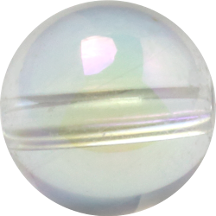
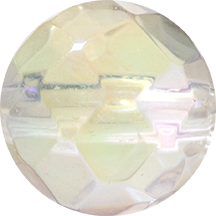
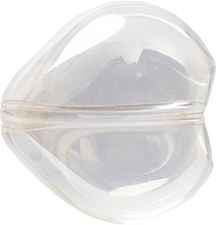
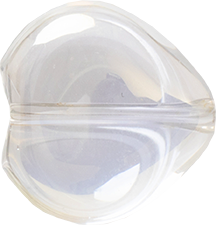
Coated Rainbow Quartz

In this sense, rainbow quartz is a trade name for treated natural quartz: colorless quartz coated in a vacuum with an extremely thin metallic film that gives its surface a rainbow-colored iridescence. The quartz is natural, but the colors are artificial and lie only on the surface. The same name is also used for naturally iridescent quartz (iris quartz), which is a different material.

Products made with this material

Category
Category
Color
Color

Colors are read from each product’s main photo.

Bead diameter (mm)
Bead diameter (mm)

Only round beads with a verified diameter. A product matches when its stated size range overlaps yours, limits included; a material matches when any of its round sizes does.

Price (USD)
Price (USD)
Availability

Showing 4 of 4 products

Full material guide
Material facts

What the material is, where it comes from or how it is made, identification and care, from the cited sources.

Properties

Nature Treated natural material: natural quartz with a vapor-deposited metallic surface coating
Base material Colorless quartz, SiO₂
Treatment Thin metallic film applied by vacuum deposition
Coating metals reported Varies: titanium or niobium (Mindat); a silver/platinum coating was reported for one rainbow-iridescent product (GIA)
Color Colorless body with rainbow-colored surface iridescence
Mohs hardness (quartz) 7; the thin coating can scratch more easily

Origins & sources

This material is produced, not found in nature. Quartz pieces are placed in a vacuum chamber, and metal is evaporated so that its atoms travel through the chamber and deposit as a film on the quartz; the film can be made up to a micron or two thick, and several metals can be deposited together. The rainbow colors are interference colors produced by the thin surface film, the same physical effect seen in an oil film on water.

Identification

The iridescence is an interference effect on the outer surface. GIA notes that once a coating is suspected it is easy for a skilled gemologist to identify, and in gold-coated "Aqua Aura" quartz it observed unnatural coloration at facet junctions and an irregular color distribution on some facets. Natural iris quartz differs because its colors come from thin films of air in internal cracks, and in quench-crackled quartz they come from induced cracks, rather than from a coating on the surface.

Care

The colors exist only in the surface film. GIA notes that thin-film coatings of any kind can scratch, especially along edges and facet junctions, and that coated quartz needs care during jewelry manufacture or repair. Keep coated pieces away from hard or abrasive objects and store them wrapped in soft material in a dry place.

History & culture

History

Metal-coated quartz entered the gem trade in the late 1980s with gold-coated "Aqua Aura". GIA reports that in the 1990s new colors and effects were created in coated quartz with different combinations of metals, including a "rainbow" iridescence reportedly caused by a silver/platinum coating (Koivula and Kammerling, 1990). Mindat records that quartz coated with titanium or niobium films has been marketed as "rainbow quartz", a name that has also been applied to several natural iridescent quartzes.

Cultural meanings

Not collected yet

Traditional beliefs

Not collected yet

Sources

Collected Oct 23, 2026