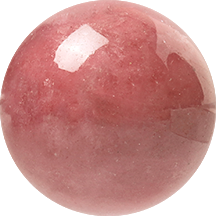
Rhodonite

Rhodonite is a natural manganese silicate mineral (rhodonite group, triclinic) with a pink to rose-red color, often veined with black manganese oxides. Massive, opaque material is widely carved into beads, cabochons and objects, while transparent faceted stones are rare because of the mineral's perfect cleavage.

Products made with this material

Category
Category
Color
Color

Colors are read from each product’s main photo.

Bead diameter (mm)
Bead diameter (mm)

Only round beads with a verified diameter. A product matches when its stated size range overlaps yours, limits included; a material matches when any of its round sizes does.

Price (USD)
Price (USD)
Availability

Showing 1 of 1 products

Full material guide
Material facts

What the material is, where it comes from or how it is made, identification and care, from the cited sources.

Properties

Nature Natural mineral; typically untreated (dyeing is rare)
Chemical formula CaMn3Mn[Si5O15] (IMA, redefined 2019); formerly simplified as MnSiO3
Crystal system Triclinic; tabular crystals, or massive, cleavable, granular
Mohs hardness 5.5–6.5
Specific gravity 3.57–3.76
Refractive index 1.711–1.752; birefringence 0.011–0.014
Color Rose red, pink, brownish red; often veined by black manganese oxides
Cleavage Perfect in one direction

Origins & sources

Rhodonite forms in or near manganese-bearing ore bodies. Sverdlovsk (Urals, Russia) yields fine massive pink to rose material; British Columbia, Canada, yields similar material, some with black dendritic patterns. Broken Hill (New South Wales, Australia) and Honshu (Japan) produce rare facetable crystals. Other sources include Värmland (Sweden), Daghazeta (Tanzania), the United States, Brazil, Mexico, Peru, South Africa and Cornwall (UK). The type locality is in the Harz, Germany.

Identification

Rhodonite's refractive index is about 1.711–1.752 (shadow edge near 1.73 in massive material) and its specific gravity 3.57–3.76. Bustamite, sometimes mislabelled as rhodonite, is paler and has distinctly lower refractive indices; pyroxmangite looks similar but differs in birefringence. Mindat notes that much material called rhodonite may actually be other rhodonite-group species and needs chemical analysis. Beads sold as "synthetic rhodonite" are of unclear nature and may simply be imitations.

Care

Do not clean rhodonite with steam or ultrasonic cleaners; use a soft brush, mild detergent and warm water. Because of its cleavage and relatively low hardness, store it separately from other stones and use protective settings to avoid scratches and blows.

History & culture

History

Rhodonite was named in 1819 by Christoph Friedrich Jasche from the Greek rhodon, "rose", for its color. Fine Russian rhodonite was used for carvings such as a Fabergé parrot now at the St. Petersburg Mining Institute, and rhodonite is the official state gemstone of Massachusetts.

Cultural meanings

Not collected yet

Traditional beliefs

Not collected yet

Sources

Collected Oct 23, 2026