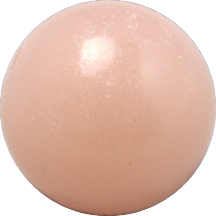
Soapstone

Soapstone, also called steatite, is a natural metamorphic rock made mostly of the soft mineral talc, with varying amounts of chlorite, micas, amphiboles, pyroxenes and carbonates. It is named for its soapy feel and softness, and is usually gray, bluish, green or brown. The pink beads sold in Japan as "soapstone" or "pink talc" were reported by the retailer Pascle, citing a Japanese gem laboratory, to be natural talc with a wax-coated surface; the sources read here do not explain their pink color. The word "soapstone" is also used loosely in the craft trade for other soft rocks such as alabaster or serpentine.

Products made with this material

Category
Category
Color
Color

Colors are read from each product’s main photo.

Bead diameter (mm)
Bead diameter (mm)

Only round beads with a verified diameter. A product matches when its stated size range overlaps yours, limits included; a material matches when any of its round sizes does.

Price (USD)
Price (USD)
Availability

Showing 1 of 1 products

Full material guide
Material facts

What the material is, where it comes from or how it is made, identification and care, from the cited sources.

Properties

Nature Natural metamorphic rock (mostly talc)
Talc formula Mg₃Si₄O₁₀(OH)₂
Color Usually gray, bluish, green or brown, often variegated; talc colors (white, gray, pale to dark green, brownish) are due to impurities; beads sold as "pink talc" are pink
Mohs hardness Talc 1; soapstone can be harder because of impurities
Specific gravity 2.20 to 2.83 (talc)
Refractive index 1.539 to 1.600; spot reading about 1.54 (talc)
Luster Greasy, waxy, pearly or dull; greasy to soapy feel
Transparency Translucent to opaque

Origins & sources

Soapstone most often forms at convergent plate boundaries, where peridotites, dunites and serpentinites are metamorphosed by heat and directed pressure; it can also form where siliceous dolostones are altered by hot, chemically active fluids. Talc occurs worldwide, often with serpentine, including many localities in the United States and in India, China, Australia, Zimbabwe, Canada and Russia; Egypt has an ancient deposit.

Identification

Soapstone feels greasy or soapy, and talc is so soft (Mohs 1) that it can be scratched easily and leaves a white powder when rubbed against other objects. Pyrophyllite-rich rocks (sold, for example, as "wonderstone" or agalmatolite) are virtually indistinguishable from talc by eye and are often sold together with soapstone; alabaster and serpentine carvings are also sometimes called soapstone. According to Pascle's published laboratory report, its pink soapstone beads carry a surface wax coating.

Care

Not collected yet

History & culture

History

People have quarried soapstone for thousands of years. Native Americans in eastern North America made bowls, cooking slabs, pipes and ornaments from it as early as 3,000 to 5,000 years ago, and people on the California coast paddled to San Clemente Island for it as early as 8,000 years ago. In Scandinavia it was carved into molds for casting metal and into cooking pots, and Inuit carvers work fine-grained steatite. The Christ the Redeemer statue in Rio de Janeiro is faced with soapstone.

Cultural meanings

Not collected yet

Traditional beliefs

Not collected yet

Sources

Collected Oct 23, 2026