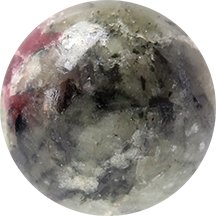
Eudialyte
 is a natural sodium-calcium zirconium silicate mineral of the trigonal eudialyte group, usually pink to deep red or brownish red. It forms in nepheline syenites and related pegmatites, and most gem material is massive rock from the Kola Peninsula, Russia, cut into cabochons, beads, spheres and carvings, often with black aegirine and white feldspar in the matrix. Transparent facetable crystals are rare and small.
Bracelet works with this material
Shared designs that use at least one piece of this material. Open one to see its pieces, buy them loose or copy it into your own designs.
- Azurmalachite, Sodalite, Dumortierite and more From the web Pieces: 44
- Azurmalachite, Sodalite, Eudialyte and more From the web Pieces: 40
- Sapphire, Black Onyx and Eudialyte From the web Pieces: 48
- Citrine, Hematite and Eudialyte From the web Pieces: 48
- Akoya Pearl, Eudialyte and Black Onyx From the web Pieces: 48
- Rock Crystal, Coated Rainbow Quartz, Azurmalachite and more From the web Pieces: 33
- Blue Fluorite, Apatite, Charoite and more From the web Pieces: 23
- Eudialyte, Garnet, Seraphinite and more From the web Pieces: 34
- Purple Tiger's Eye, Rock Crystal, Eudialyte and more From the web Pieces: 30
- Morion, Lava Stone, Tektite and more From the web Pieces: 22
- Eudialyte, Rock Crystal, Chrysocolla and more From the web Pieces: 40
- Terahertz Stone, Hematite, Eudialyte and more From the web Pieces: 30
- Terahertz Stone, Gibeon Meteorite, Chondrite and more From the web Pieces: 30
- Black Spinel, Izumo Stone, Eudialyte and more From the web Pieces: 36
- Botswana Agate and Eudialyte From the web Pieces: 44
- Dragon Agate and Eudialyte From the web Pieces: 44
- Eagle Eye and Eudialyte From the web Pieces: 44
- Eudialyte and Botswana Agate From the web Pieces: 44
- Eudialyte and Dragon Agate From the web Pieces: 44
- Eudialyte and Apatite From the web Pieces: 44
- Eudialyte and Bloodstone From the web Pieces: 44
- Eudialyte and Carnelian From the web Pieces: 44
- Eudialyte and Charoite From the web Pieces: 44
- Eudialyte and White Chalcedony From the web Pieces: 44
- Eudialyte and Eagle Eye From the web Pieces: 44
- Eudialyte and Emerald From the web Pieces: 44
- Eudialyte and Eye Agate From the web Pieces: 44
- Eudialyte and Green Garnet From the web Pieces: 44
- Eudialyte and Hematite From the web Pieces: 44
- Eudialyte and Howlite (magnesite) From the web Pieces: 44
- Eudialyte and Lapis lazuli From the web Pieces: 44
- Eudialyte and Morion From the web Pieces: 44
- Eudialyte and Mother-of-Pearl From the web Pieces: 44
- Eudialyte and Dragon Eye (green opal) From the web Pieces: 44
- Eudialyte and Golden Rutilated Quartz From the web Pieces: 44
- Eudialyte and Sapphire From the web Pieces: 44
- Eudialyte and Sodalite From the web Pieces: 44
- Eudialyte and Smoky Quartz From the web Pieces: 44
- Eudialyte and Hawk's Eye From the web Pieces: 44
- Eudialyte and Zeolite From the web Pieces: 44
- Eye Agate and Eudialyte From the web Pieces: 44
- Hematite and Eudialyte From the web Pieces: 44
- Howlite (magnesite) and Eudialyte From the web Pieces: 44
- Black Jade and Eudialyte From the web Pieces: 44
- Golden Obsidian and Eudialyte From the web Pieces: 44
- Smoky Quartz and Eudialyte From the web Pieces: 44
- Zeolite and Eudialyte From the web Pieces: 44
Loose materials of this stone marked Love
Traditional meaning: Love
Only this stone’s materials that Pascle’s data marks with Love are listed, not every material of the stone.
Showing 1 of 1 products