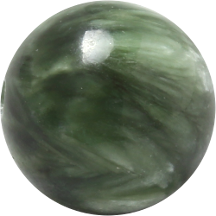
Seraphinite
 is a trade name for a natural, dense, fine-grained variety of clinochlore, a soft magnesium-aluminium silicate of the chlorite group, whose radiating, feather-like (plumose) structure gives a silvery shimmer on a dark green to grey ground. It is used for carving and as a decorative stone. Mindat records it from the Korshunovskoye iron deposit in Irkutsk Oblast, Siberia, Russia.
Bracelet works with this material
Shared designs that use at least one piece of this material. Open one to see its pieces, buy them loose or copy it into your own designs.
- Rock Crystal, Labradorite and Seraphinite From the web Pieces: 36
- Morion, Hematite (rainbow, 32-facet cut), Smoky Quartz and more From the web Pieces: 32
- Green Aventurine, Seraphinite, Rock Crystal and more From the web Pieces: 39
- Black Spinel, Smoky Quartz, Garnet and more From the web Pieces: 26
- Shungite, Smoky Quartz, Black Jade and more From the web Pieces: 34
- Moonstone, Blue Moonstone, Impression Stone and more From the web Pieces: 36
- Amazonite, Prehnite, Aragonite and more From the web Pieces: 40
- Rock Crystal, Gray Moonstone, Blue Moonstone and more From the web Pieces: 30
- Rock Crystal, Lapis lazuli, Aquamarine and more From the web Pieces: 18
- Larimar, Moldavite, Tokachi-ishi and more From the web Pieces: 19
- Seraphinite, Gray Moonstone, River Stone and more From the web Pieces: 32
- Rose quartz, Rock Crystal, Garnet and more From the web Pieces: 32
- Iolite, Seraphinite, Black Onyx and more From the web Pieces: 30
- Garnet, Rock Crystal, Citrine and more From the web Pieces: 28
- Amazonite, Prehnite, Aragonite and more From the web Pieces: 40
- Rock Crystal, Smoky Quartz, Angel Silica and more From the web Pieces: 34
- Howlite (magnesite), Sardonyx, Aquamarine and more From the web Pieces: 34
- Rock Crystal, Iolite, Amazonite and more From the web Pieces: 42
- Malachite, Bloodstone, Green Fluorite and more From the web Pieces: 24
- Shungite, Morion, Eye Agate and more From the web Pieces: 28
- Azurmalachite, Larvikite, Petrified Wood and more From the web Pieces: 24
- Carnelian, Morion, Eye Agate and more From the web Pieces: 20
- Morion, Eye Agate, Seraphinite and more From the web Pieces: 24
- Pyrite, Selenite, Terahertz Stone and more From the web Pieces: 22
- Rock Crystal, Smoky Quartz, Angel Silica and more From the web Pieces: 35
- Morion, Rock Crystal, Seraphinite and more From the web Pieces: 36
- Seraphinite, Morion, Labradorite and more From the web Pieces: 38
- Black Onyx, Rock Crystal, Carnelian and more From the web Pieces: 33
- Black Onyx, Green Tiger's Eye, Pyrite and more From the web Pieces: 24
- Green Tiger's Eye, Onyx (white) and Seraphinite From the web Pieces: 32
- Green Tiger's Eye, Milky Quartz, Seraphinite and more From the web Pieces: 40
- Rock Crystal, Blue Lace Agate, Crackle Quartz and more From the web Pieces: 44
- Green Fluorite, Himalayan Quartz, Moss Agate and more From the web Pieces: 32
- Lemon Quartz, Blue Moonstone, Seraphinite and more From the web Pieces: 30
- Black Onyx, Rock Crystal, Seraphinite and more From the web Pieces: 36
- Seraphinite, Rock Crystal, Akoya Pearl and more From the web Pieces: 36
- Eudialyte, Garnet, Seraphinite and more From the web Pieces: 34
- Seraphinite, Howlite (magnesite), Golden Obsidian and more From the web Pieces: 38
- Lapis lazuli, Larimar, Rock Crystal and more From the web Pieces: 32
- Dumortierite, Seraphinite, Golden Rutilated Quartz and more From the web Pieces: 28
- Seraphinite, Golden Aura, Red Jasper and more From the web Pieces: 34
- Seraphinite, Kyanite, Itoigawa Jade and more From the web Pieces: 20
- Rock Crystal, Itoigawa Jade, Jadeite and more From the web Pieces: 19
- Quartzite (blue), Jadeite, Golden Rutilated Quartz and more From the web Pieces: 28
- Santa Maria Aquamarine, Itoigawa Jade, White Labradorite and more From the web Pieces: 27
- Crackle Quartz, Aquamarine, Vesuvianite and more From the web Pieces: 26
- Rock Crystal, Green Garnet, Golden Aura and more From the web Pieces: 39
- Seraphinite, Rock Crystal, Carnelian and more From the web Pieces: 36
- Green Fluorite, Akoya Pearl, Seraphinite and more From the web Pieces: 28
- Seraphinite, Golden Rutilated Quartz and Golden Aura From the web Pieces: 40
- Azurmalachite, Dumortierite, Seraphinite and more From the web Pieces: 25
- Onyx (white), Rock Crystal, Mother-of-Pearl and more From the web Pieces: 30
- Rock Crystal, Howlite (magnesite), Jadeite and more From the web Pieces: 38
- Seraphinite, Golden Obsidian, Serpentine and more From the web Pieces: 24
- Rock Crystal, Green Fluorite and Seraphinite From the web Pieces: 22
- Rock Crystal, Green Fluorite, Jadeite and more From the web Pieces: 28
- Rock Crystal, Golden Rutilated Quartz, Seraphinite and more From the web Pieces: 43
- Dalmatian Stone, Seraphinite, K2 Granite and more From the web Pieces: 24
- Obsidian (black ice), Onyx (white), Golden Obsidian and more From the web Pieces: 35
- Lepidolite, Morion, Seraphinite and more From the web Pieces: 28
Showing the newest 60 of 171 works. See all designs
Loose materials of this stone marked Love
Traditional meaning: Love
Only this stone’s materials that Pascle’s data marks with Love are listed, not every material of the stone.
Showing 1 of 1 products